Welcome to Our Company
 Send Email
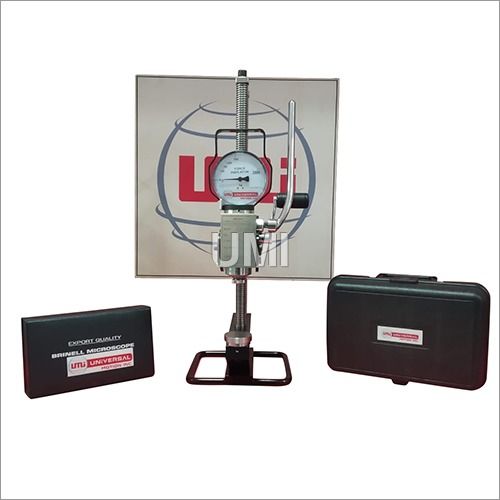
Portable Hydraulic Brinell Hardness Tester
350000.00 INR/Piece
Product Details:
- Product Type Portable
- Weight 12 Kilograms (kg)
- Operate Method manual
- Application To check BHN Hardness of material
- Usage Industries, field
- Dimension (L*W*H) 12*12*24 Inch (in)
- Click to view more
X
Portable Hydraulic Brinell Hardness Tester Price And Quantity
- 350000.00 INR/Piece
- 4500.00 - 5000.00 INR/Piece
- 1 Piece
Portable Hydraulic Brinell Hardness Tester Product Specifications
- manual
- Portable
- Industries, field
- 12*12*24 Inch (in)
- 12 Kilograms (kg)
- To check BHN Hardness of material
Portable Hydraulic Brinell Hardness Tester Trade Information
- 100 Piece Per Day
- 7 Days
- North America, Australia, Middle East, Africa, Central America, South America, Asia, Western Europe, Eastern Europe
- All India
Product Description
Backed with several years of market experience, we are providing a wide array of Portable Hydraulic Brinell Hardness Tester. It is used for hardness determination of cast iron as well as alloy materials. Apart from this, provided tester is used to determine the hardness in circumstances. Portable Hydraulic Brinell Hardness Tester measures the effect on its surface of a localized penetration. It controls circuit for effortless loading unloading operation. It is able to measure depth of ball penetration.
Product Details
Parameter | HB |
Display Type | Analog |
Model Name/Number | UNIB-3000P |
Accuracy | 1% |
Automation Grade | Manual |
Weight | 12 kg |
Country of Origin | Made in India |
Reliable Hardness Testing Anywhere
Engineered for portability and efficiency, this hydraulic Brinell hardness tester is ideal for conducting reliable BHN measurements at any location. Its manual operation allows engineers and technicians to perform accurate material checks, even in remote or challenging work environments. The robust build and user-friendly design ensure consistent results.
Versatile Application in Industries
Suitable for a wide range of sectors, this hardness tester is routinely employed in factories, workshops, and outdoor sites. It caters to the needs of quality assurance teams who require dependable BHN evaluation of metals and alloys, directly supporting production standards and component validation without the need for permanent lab installations.
FAQ's of Portable Hydraulic Brinell Hardness Tester:
Q: How do you operate the Portable Hydraulic Brinell Hardness Tester?
A: Operation of the tester is manual; simply position the device on the test specimen, apply the specified hydraulic force, and use the testing mechanism to create an indentation. After removing the tester, measure the impression to determine the Brinell Hardness Number (BHN) as per standard methods.Q: What materials can be tested with this device?
A: This portable hardness tester can evaluate the BHN of a wide range of metals and alloys commonly used in industries. It is suitable for components where accurate hardness assessment is essential for quality and durability.Q: When is it most beneficial to use a portable hardness tester instead of a fixed system?
A: A portable tester is most advantageous when testing needs to be performed on-site or on large or immovable components, making it unnecessary or impractical to transport samples to a laboratory. Its portability saves time, logistical cost, and allows for immediate assessments.Q: Where can the Portable Hydraulic Brinell Hardness Tester be used?
A: This product is suitable for use in industrial workshops, manufacturing plants, outdoor construction sites, and quality inspection areas. Its compact design and moderate weight make it convenient to carry and deploy wherever hardness testing is required.Q: What is the process for checking the BHN hardness of a material?
A: To check BHN, position the tester on the material, apply the hydraulic load to the indenter, then remove the tester and measure the resulting indentation. The measurement is used to calculate the Brinell Hardness Number following standard procedures.Q: What are the key benefits of using this manual hardness tester?
A: The key benefits include portability, ease of manual use, fast setup, and the ability to perform hardness assessments on-site. This enhances efficiency in quality control processes and supports real-time decision-making for material acceptance or rejection.Tell us about your requirement

Price:
Quantity
Select Unit
- 50
- 100
- 200
- 250
- 500
- 1000+
Additional detail
Mobile number
Email

Other Products in 'Brinell Hardness Tester' category




Contact Details

- 203, The Business Center, Erandwane, Near Sanjivan Hospital, Pune - 411004, Maharashtra, India
- Phone : 08045811420
- Send Inquiry
GST : 27AAVPD3179J1Z6
 Send Inquiry
- Mr. Sanjay Dengare (Proprietor)
- Mobile : 08045811420
 Send Inquiry
 Send SMS
 Call Me Free

UNIVERSAL MOTION INC.
All Rights Reserved.(Terms of Use)
Developed and Managed by Infocom Network Private Limited.
Developed and Managed by Infocom Network Private Limited.


 English
 Spanish
 French
 German
 Italian
 Chinese (Simplified)
 Japanese
 Korean
 Arabic
 Portuguese